The Doctor Who Saved His Own Life With a Mirror and a Scalpel in the World's Loneliest Place
When Your Only Patient Is Yourself
Picture this: You're 1,200 miles from the nearest hospital, surrounded by nothing but ice and penguins, and your appendix decides to stage a rebellion that could kill you within days. Your only hope for survival is performing surgery on yourself while conscious, using a handheld mirror to see what you're doing.
This wasn't a thought experiment or a medical school hypothetical. This was Tuesday, April 30, 1961, at the Novolazarevskaya Antarctic research station, and Soviet doctor Leonid Rogozov was about to attempt something that belonged more in a horror movie than a medical journal.
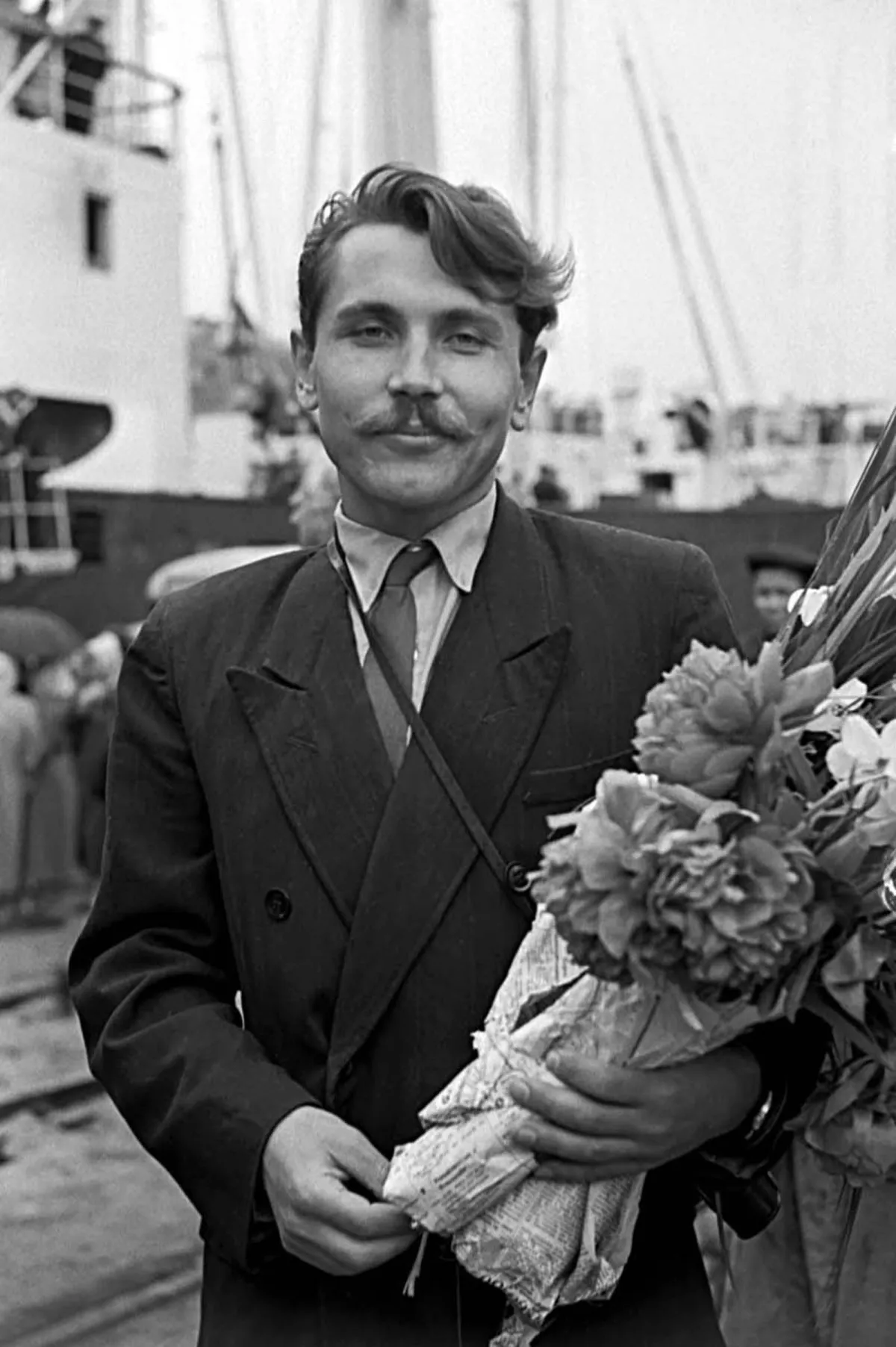 Photo: Leonid Rogozov, via blogger.googleusercontent.com
The Loneliest Medical Emergency on Earth
Rogozov was 27 years old and the only doctor among the twelve-man Soviet research team stationed at one of the most remote locations on the planet. When he woke up that morning with severe abdominal pain, nausea, and fever, his medical training told him exactly what was happening: acute appendicitis.
In Moscow, this would have meant a routine trip to the hospital. In Antarctica, during the polar winter with temperatures hitting minus-60 degrees Fahrenheit, it meant a death sentence. No planes could fly in those conditions. No ships could navigate the frozen seas. The nearest medical facility was literally on another continent.
Rogozov's teammates suggested waiting for a weather break, but he knew the math. Untreated appendicitis typically progresses to fatal peritonitis within 72 hours. Even if rescue became possible, which it wouldn't for months, he'd be dead long before help arrived.
The Calmest Man in the Room Was the Patient
What happened next defies every instinct of self-preservation. Rogozov made a decision that sounds insane until you realize it was the only rational choice available: he would operate on himself.
He spent the next day meticulously planning the procedure. Using the station's radio, he consulted with surgeons back in the Soviet Union, though the crackling long-distance connection made detailed guidance nearly impossible. He studied anatomy textbooks, reviewing every detail of appendectomy procedures he'd performed on others.
Most remarkably, Rogozov approached his own potential death with the same clinical detachment he'd bring to any other patient. His diary entries from those days read like standard medical notes, devoid of panic or self-pity.
Surgery by Mirror in the Middle of Nowhere
On May 1st, Rogozov set up an improvised operating theater in the station's common room. He arranged mirrors to give himself the best possible view of his own abdomen, positioned surgical instruments within easy reach, and briefed his non-medical teammates on how to assist.
Two men held mirrors and a lamp to provide illumination. Another stood ready to hand him instruments. A fourth was assigned to monitor his pulse and breathing. None of them had any medical training beyond basic first aid.
Rogozov injected himself with local anesthesia and made the first incision. Working primarily by feel and using the mirrors to guide his movements, he began cutting through layers of muscle and tissue to reach his appendix.
The Longest Hour in Medical History
What followed was an hour of surgical precision that defied human limitations. Rogozov had to work with his hands essentially upside down, reading his own anatomy in reverse through mirrors while fighting waves of nausea and weakness.
Halfway through the procedure, he nearly passed out. His assistants later reported that he went pale and his hands started shaking, but he refused to stop. Taking a brief rest, he continued cutting.
The most terrifying moment came when he couldn't immediately locate his appendix. In a normal surgery, he could have repositioned the patient or called for better lighting. Operating on himself, he had to rely on touch alone, carefully feeling around inside his own abdomen while fighting the urge to vomit.
When he finally found and removed the inflamed appendix, it was already beginning to perforate — confirming that waiting even another day would have been fatal.
The Recovery That Shocked Moscow
Rogozov sutured himself up, cleaned and bandaged the wound, and then did something that amazed his teammates: he calmly gave them post-operative care instructions for monitoring his recovery.
He spent the next week in bed, checking his own temperature, monitoring for signs of infection, and changing his own dressings. His teammates followed his instructions for administering antibiotics and pain medication.
Two weeks later, Rogozov was back on his feet. A month later, he was fully operational and resumed his duties as the station's doctor. When the research team returned to the Soviet Union eight months later, medical examinations confirmed that his self-surgery had been performed flawlessly.
The Story That Almost Stayed Secret
For years, Rogozov's feat remained largely unknown outside Soviet medical circles. The Cold War meant that remarkable achievements on either side rarely crossed ideological boundaries. Western medical journals didn't learn about the self-appendectomy until the 1980s.
Even today, most people have never heard of Leonid Rogozov, despite his having accomplished something that medical experts still consider nearly impossible. The combination of surgical skill, psychological fortitude, and sheer luck required to succeed makes his survival statistically miraculous.
The Doctor Who Redefined Possible
Rogozov returned to Antarctica several more times during his career, though never again as the only doctor. He went on to become a respected surgeon in St. Petersburg, where he worked until his retirement.
When asked about the self-surgery in later interviews, Rogozov displayed the same matter-of-fact attitude that had carried him through the operation. He described it as "simply what had to be done," without any hint of bravado or self-congratulation.
Medical schools now study Rogozov's case as an example of extreme surgical improvisation, though no one recommends attempting to replicate it. Modern Antarctic research stations are staffed with multiple medical personnel and have evacuation procedures that didn't exist in 1961.
The Mirror That Saved a Life
Rogozov kept the mirrors he used during the surgery for the rest of his life. They sat on his desk at home, looking like ordinary household items that happened to have participated in one of medicine's most extraordinary moments.
His story stands as a testament to what humans can accomplish when survival instincts combine with professional skill and absolute necessity. In a world where medical miracles usually involve teams of specialists and millions of dollars in equipment, Leonid Rogozov saved his own life with nothing but knowledge, courage, and a reflection.
It's the kind of story that sounds too incredible to be true — until you remember that sometimes reality is stranger than anything fiction could invent.