A Rock from Space Killed a Man in 1888 — But Not the Way You'd Think
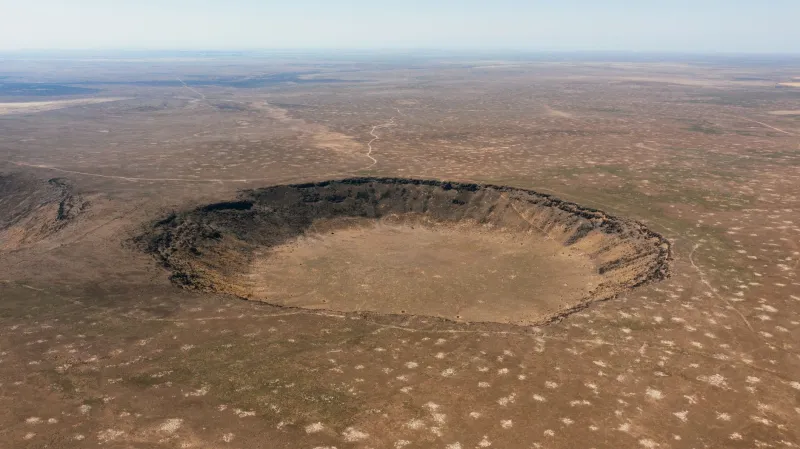
When most people imagine dying from a meteorite, they picture a direct hit — a fireball screaming out of the sky, a violent impact, and that's that. Clean, if terrifying. Cosmically final.
The reality of what happened in the Sulaymaniyah region of what is now Iraq in 1888 was far weirder. A man died. A meteorite was absolutely involved. But the chain of events connecting those two facts reads less like an astronomy textbook and more like a particularly cruel cosmic joke.
The Record That Sat Quietly for Over a Century
For most of the 20th century, the scientific community largely held that no human being had ever been confirmed killed by a meteorite. There were close calls, property damage, a few bruises and broken bones — but a death? Nothing solid enough to stake a claim on.
Then researchers began combing through Ottoman administrative records, and they found something buried in the bureaucratic language of an 1888 government dispatch: a report describing a meteorite fall near Sulaymaniyah that had, according to local officials, resulted in one man dead and another paralyzed.
The document was genuine. The event had been formally reported to Ottoman authorities. Suddenly, the scientific community had what appeared to be the oldest confirmed human fatality linked to a meteorite strike — and the details of exactly how it happened were deeply unsettling.
What the Rock Actually Did
Here's where the story takes its turn. The meteorite didn't kill the man by striking him directly. According to the historical account, the impact — or the shockwave, the displacement of earth and debris, the sheer physical violence of a space rock hitting the ground nearby — set off a cascade of events that proved fatal.
The man was close enough to the impact zone that the force of the strike, combined with the resulting chaos of flying debris, was sufficient to cause his death. His companion survived but was left unable to walk.
In other words, the meteorite killed a man the way a car accident kills a pedestrian who wasn't even in the road — through proximity, force, and the brutal indifference of physics.
Why This Took Decades to Fully Establish
The Ottoman record was compelling, but science demands more than a government dispatch. Researchers had to cross-reference the report with known meteorite falls in the region, examine the timeline, and assess whether the physical description of the event matched what we know about meteorite impacts.
The work was painstaking. The region had experienced documented meteorite activity. The administrative language was consistent with genuine incident reporting rather than myth or exaggeration. Gradually, the scientific consensus shifted: this appeared to be real.
What made verification particularly tricky was the nature of the fatality itself. A direct hit leaves obvious evidence — impact trauma, a wound pattern that matches a high-velocity projectile. A death caused by the consequences of an impact is murkier. It required historians and scientists to collaborate in ways that don't come naturally to either group.
The Rarity That Makes This So Remarkable
Here's a number that will recalibrate your sense of cosmic risk: scientists estimate that the odds of any individual human being struck by a meteorite in their lifetime are somewhere in the neighborhood of one in 100 trillion. You are more likely to be struck by lightning while simultaneously winning the lottery than you are to take a direct hit from space rock.
And yet Earth gets pelted constantly. Tens of thousands of meteorites reach the surface every year — most of them tiny, most landing in oceans or uninhabited wilderness. The planet is enormous. People are small. The math works in our favor, overwhelmingly.
Which is precisely what makes the 1888 case so jarring. Not only did a meteorite land close enough to humans to cause harm, but the manner of that harm defied the obvious scenario entirely. No one was struck. The rock simply arrived, and the arriving was enough.
The One Person Who Did Get Hit (And Lived)
For the record, there is one confirmed case of a person being directly struck by a meteorite and surviving: Ann Hodges of Sylacauga, Alabama, who in 1954 was hit by an 8.5-pound rock that punched through her roof, bounced off a radio console, and struck her in the hip, leaving a bruise the size of a football.
She recovered. She became briefly famous. The meteorite ended up in a museum.
Hodges always said the whole thing felt unreal — that the universe had reached down and tapped her on the shoulder for no reason at all, then moved on. Given what happened to the unnamed man in 1888, she may have gotten off easy.
What the Sky Owes Us
The 1888 case remains an outlier, a footnote at the extreme edge of human experience with the cosmos. It's the kind of story that makes you look up at the night sky with a slightly different feeling than you had before — not quite fear, but something adjacent to it. A reminder that the universe operates on its own schedule, by its own rules, and occasionally those rules intersect with ours in ways we never see coming.
A man died because a rock fell out of the sky nearby. That sentence contains no exaggeration. Every word of it is true.
Somehow, that makes it worse.