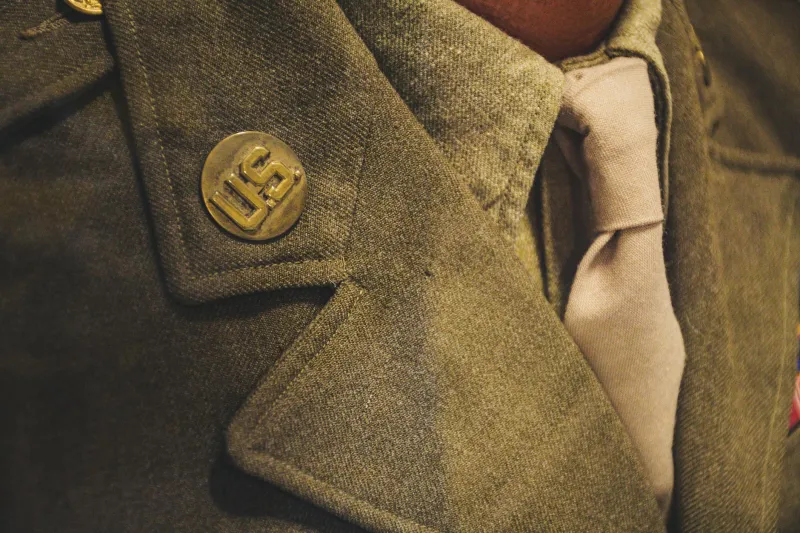
When Your Own Army Declares War on You
Staff Sergeant Robert Chen thought the worst part of being a prisoner of war was the daily interrogations, the meager food rations, and the constant threat of execution. He had no idea that back home, his own military had officially declared him an enemy of the United States—while he was chained to a wall in a German prison camp, still wearing his American uniform.
 Photo: Staff Sergeant Robert Chen, via assets.skool.com
The bureaucratic nightmare that would haunt Chen for decades began on a rainy morning in November 1944, somewhere outside the French village of Metz. Chen's unit, the 357th Infantry Regiment, was advancing through heavy German resistance when they were cut off and surrounded. Chen and twelve other soldiers were captured after a firefight that left half their squad dead.
What should have been a straightforward prisoner-of-war case became one of the most bizarre administrative failures in military history—a cascade of paperwork errors that transformed a decorated combat veteran into an official enemy of the state he'd risked his life to defend.
The Fatal Form
The trouble started with Army Form 1156-B, a standard personnel status report that field commanders were required to file whenever soldiers went missing in action. Chen's commanding officer, Lieutenant James Morrison, was supposed to check a box indicating "Missing in Action - Presumed Captured." Instead, in the chaos following the firefight, Morrison accidentally marked "Absent Without Leave - Presumed Desertion."
It was a simple mistake—one checkbox instead of another—but it set off a chain reaction through the Army's personnel system that would prove nearly impossible to stop.
The form traveled from the battlefield to divisional headquarters to the Pentagon, where clerks processed it without question. In the Army's bureaucratic logic, a soldier marked as a deserter who then appeared in German prisoner lists must have voluntarily surrendered to the enemy.
The Evidence Mounts
Within weeks, Chen's case file began accumulating damning "evidence" of his supposed treachery. Army intelligence analysts, working with incomplete information, constructed a narrative that painted him as a willing collaborator.
The fact that Chen had been captured alive while others in his unit died was interpreted as suspicious. His appearance in German propaganda photographs—standard practice for POW camps seeking to demonstrate compliance with Geneva Convention documentation requirements—was seen as evidence of cooperation.
Most damning of all, Chen's name appeared on a list of American prisoners who had allegedly provided information to their captors. What the analysts didn't know was that the list had been compiled by German intelligence officers who routinely fabricated cooperation reports to sow distrust among Allied forces.
By spring 1945, Chen's military file contained a formal recommendation for court-martial proceedings on charges of desertion, aiding the enemy, and treason. The Army had built an airtight case against a man who was, at that very moment, being beaten unconscious in a Nazi prison camp for refusing to reveal American troop positions.
Liberation and Accusation
When Allied forces liberated Chen's prison camp in April 1945, he expected to be treated as a returning hero. Instead, he was immediately separated from other freed prisoners and placed under armed guard.
"They told me I was under investigation for desertion and collaboration," Chen later recalled. "I thought it was some kind of mistake that would be cleared up in a few hours. I had no idea it would take an act of Congress to prove I wasn't a traitor."
Chen spent three months in military detention while investigators tried to reconcile the official record with the physical evidence of his ordeal. His medical examination revealed signs of prolonged torture, malnutrition, and injuries consistent with combat and imprisonment. But his file still contained that original form marking him as a deserter.
The Bureaucratic Maze
Army regulations required that any change to a soldier's official status be supported by sworn affidavits from witnesses and commanding officers. But Lieutenant Morrison had been killed in action two days after filing the incorrect form. Most of Chen's unit was either dead or scattered across different hospitals and discharge centers.
The few surviving members of Chen's squad provided statements confirming his capture, but their testimony was considered "interested party" evidence that couldn't override official documentation. In the Army's view, paperwork trumped eyewitness accounts.
Meanwhile, Chen's classification as a suspected collaborator affected every aspect of his post-war life. He was denied veterans' benefits, discharged without honor, and flagged in FBI files as a potential security risk. His applications for civilian employment were routinely rejected when background checks revealed his military status.
The Fight for Recognition
Chen spent the next fifteen years fighting to clear his name. He hired lawyers, contacted congressmen, and submitted countless appeals to military review boards. Each time, he was told that changing his official record would require new evidence that simply didn't exist.
The breakthrough came in 1961, when a former German intelligence officer published his memoirs and revealed the systematic fabrication of prisoner cooperation reports. The book specifically mentioned Chen's case as an example of how false information had been used to undermine Allied morale.
Armed with this evidence, Chen's lawyer petitioned Congress directly. The case attracted media attention, and public pressure finally forced the Pentagon to conduct a comprehensive review of his file.
Justice, Finally
In 1963, Congress passed a special resolution officially exonerating Chen and restoring his military honors. The legislation acknowledged that "administrative errors and enemy disinformation" had created a "grave injustice" against a soldier who had served with distinction.
Chen was awarded the Bronze Star for his actions during the firefight that led to his capture, and he received full veterans' benefits retroactive to his discharge date. The Army also implemented new procedures requiring multiple verification steps before changing a soldier's status from missing to deserter.
But perhaps the most significant outcome was Chen's own perspective on the ordeal. "I fought two wars," he often said in later interviews. "One against the Germans, and one against my own paperwork. The paperwork was harder to defeat."
The Lasting Lesson
Chen's case became a cautionary tale about the power of bureaucratic systems to create their own reality, regardless of facts on the ground. A single checkbox error had transformed a war hero into a traitor, and it took nearly two decades to undo the damage.
The story reveals how institutional momentum can carry obviously false narratives forward, especially when those narratives are supported by official documentation. In Chen's case, the Army's faith in its own paperwork was so complete that physical evidence of torture was considered less reliable than a hastily completed form.
Today, Chen's military file is displayed at the National Archives as an example of how administrative failures can have profound human consequences. It serves as a reminder that even in matters of life and death, sometimes the most dangerous enemy is the one wearing your own uniform—especially when it's carrying a clipboard.
 Photo: National Archives, via uploads.hoop.co.uk