An Entire Roman City Vanished for 1,600 Years — And When It Came Back, the Bread Was Still on the Table
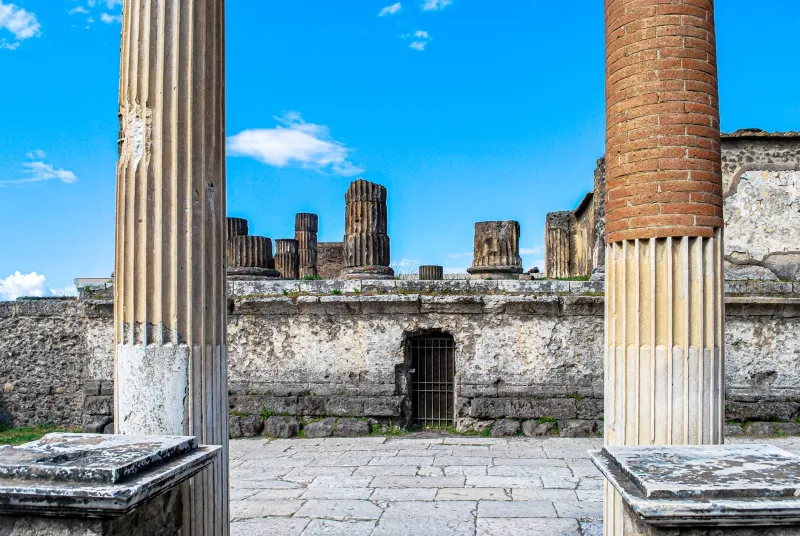
Everyone has heard of Pompeii. It's one of those historical disasters that lodged itself permanently into the cultural imagination — the volcano, the ash, the frozen figures, the cautionary tale about nature's indifference to human civilization. School trips, documentaries, HBO series. Pompeii is famous.
Herculaneum is not famous. And that's genuinely strange, because what happened to Herculaneum — and what was found when it finally resurfaced — is, in several ways, even more extraordinary.
The Town That Vesuvius Swallowed Whole
In August of 79 AD, Mount Vesuvius erupted with a violence that reshaped the entire Bay of Naples. Pompeii, located about five miles southeast of the volcano, was buried under a thick blanket of volcanic ash and pumice. Herculaneum, a smaller but considerably wealthier resort town sitting almost directly at the volcano's base, got something different.
It got the pyroclastic surge — a superheated avalanche of gas, ash, and rock moving at hurricane speed and temperatures that researchers now estimate reached somewhere between 750 and 900 degrees Fahrenheit. The surge hit Herculaneum so fast and so completely that it didn't bury the town gradually the way ash buried Pompeii. It entombed it. Instantly. Under roughly 60 feet of volcanic material that hardened over time into something closer to concrete than soil.
Pompeii disappeared under a layer of debris. Herculaneum disappeared from the earth entirely.
And then it stayed that way. For 1,659 years.
A City That Forgot It Had Ever Existed
Here's what makes the disappearance of Herculaneum particularly strange: people knew it had existed. Ancient Roman writers mentioned it. It appeared in historical records. But over the centuries, the exact location simply... blurred. The town of Resina grew up on top of the volcanic crust, and generation after generation of residents had no idea what was underneath their feet.
By the medieval period, Herculaneum had passed from historical footnote into something closer to legend. Scholars debated where exactly it had stood. Some guessed correctly — roughly. But there was no physical evidence, no ruins poking through the ground, nothing to confirm it. The volcano had done a thorough job.
Then, in 1709, a well-digger near Resina broke through into what appeared to be an ancient theater. Carved marble started coming up with the dirt. Word spread, and the local prince began quietly excavating — not for history's sake, but for decorative marble and statues to furnish his estate. It was essentially looting, conducted with shovels.
Formal excavation didn't begin until 1738, when King Charles III of Naples authorized a proper archaeological investigation. And that's when things got genuinely surreal.
What They Found
Herculaneum hadn't just been preserved. It had been sealed. The same volcanic material that made excavation brutally difficult — workers had to chip through solid rock rather than sift through ash — had acted as a perfect vacuum seal for nearly seventeen centuries.
Archaeologists found wooden furniture still standing in place. Not rotted, not collapsed — standing. They found shelves with dishes still on them. They found a loaf of bread in an oven, carbonized but intact, still shaped exactly as the baker had left it on an August morning in 79 AD. The bread now lives in the National Archaeological Museum of Naples, and it is genuinely one of the more unsettling objects you can look at — ordinary and ancient and impossible all at once.
They found the Villa of the Papyri, a sprawling private estate that contained over 1,800 scrolls — the only intact library to survive from the ancient world. Most were carbonized into fragile black cylinders, and for decades scholars assumed they were simply unreadable. In recent years, advanced imaging technology including X-ray and infrared scanning has begun to decode them, and researchers are still actively unrolling their contents. Some of the texts recovered are works by philosophers whose writing was thought to be entirely lost.
They also found the people.
The Ones Who Didn't Make It Out
For a long time, archaeologists assumed Herculaneum had been largely evacuated before the pyroclastic surge hit. Pompeii had yielded hundreds of bodies. Herculaneum had almost none — which seemed to suggest the residents had escaped.
Then, in the 1980s, excavators reached the ancient shoreline — the beach where the town's harbor had once been. There they found the boat storage chambers, arched vaults built into the seawall. And inside them, huddled together, were the remains of over 300 people.
They had gathered at the water, presumably waiting for boats that never came. When the pyroclastic surge hit, it killed them so instantaneously that their skeletons were found in positions that suggested they had no time to react. Researchers analyzing the bones found evidence of extreme thermal shock — temperatures so high, so fast, that soft tissue essentially vaporized. One analysis suggested death occurred in less than a second.
The boat chambers are among the most haunting archaeological spaces in the world. They're still there. Visitors can see them.
A City Still Being Uncovered
Here's the part that tends to surprise people: Herculaneum is not fully excavated. Not even close.
The modern town of Ercolano — the successor to Resina — sits directly over a large portion of the ancient city. Excavating beneath it would require demolishing homes, businesses, and streets that people currently live and work on. The ethical and logistical complications are enormous, and so much of Herculaneum remains underground, waiting.
Estimates suggest that only about a quarter of the ancient city has been uncovered. The rest — more wooden furniture, more scrolls, more bread, more stories — is still down there, sealed in volcanic rock under a modern Italian neighborhood.
What's already been found rewrote significant portions of what historians understood about Roman daily life — the layout of homes, the diet of ordinary people, the contents of private libraries, the way a prosperous Roman resort town actually functioned on an ordinary day.
All of it preserved because a volcano buried it too fast and too deep for time to touch it.
Sometimes the things that disappear most completely are the ones that come back the most intact.