She Picked a Fight With Her Husband's Medicine — and Accidentally Changed Surgery Forever
Marriage, historically, has not been the most fertile ground for scientific revolution. But every now and then, a domestic disagreement produces something that outlasts the couple entirely — something that ends up in textbooks, in hospitals, in the hands of surgeons who have no idea it started with a stubborn woman at a kitchen table trying to prove a point.
This is one of those stories.
The Disagreement That Started Everything
In the latter half of the 19th century, a period when medicine was transitioning from guesswork to something approaching actual science, the household of a prominent surgeon became the unlikely site of a genuine medical breakthrough.
The woman at the center of this story — working in an era when women were largely excluded from formal medical training and institutional research — had absorbed enough of her husband's professional conversations to form her own opinions about what he was doing wrong. And she had one very specific objection.
Her husband held a view common among surgeons of the time: that a particular approach to wound treatment and tissue preparation was correct, effective, and not worth questioning. She disagreed. She thought the underlying logic was flawed and that a different method would produce better outcomes. He dismissed her. She did what any reasonable person in an unreasonable situation would do: she went and tested it herself.
The Kitchen Table as Laboratory
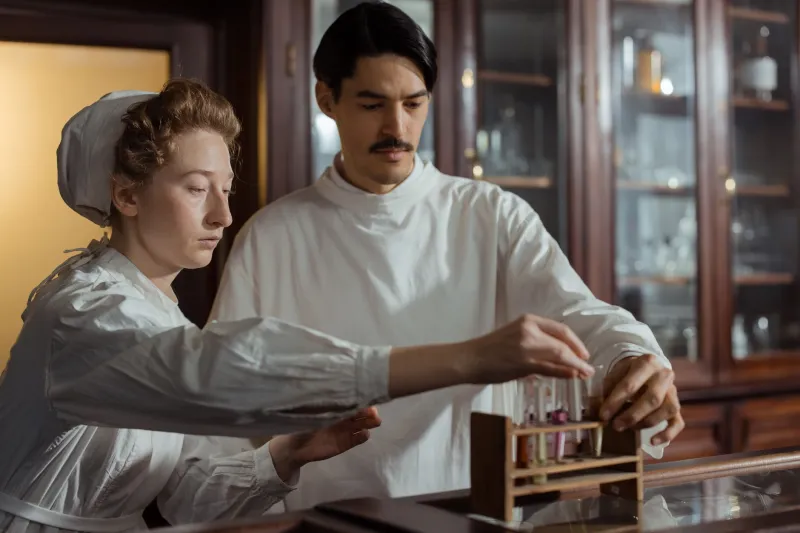
With no institutional backing, no formal credentials, and no permission from anyone, she designed a rudimentary but methodologically sound series of tests in her home. She was meticulous about it — recording observations, controlling variables as best she could with the materials available to her, and repeating the process enough times to feel confident in what she was seeing.
What she found contradicted her husband's position directly. Her approach produced measurably better results. The tissue responses she observed aligned with a theory she had developed through reading and careful reasoning rather than formal training.
She documented everything and presented it to her husband. The reception, as you might imagine, was not warm.
When Home Science Meets Professional Resistance
The story of what happened next is a familiar one in the history of women in science: the discovery existed, the evidence was real, and the person who made it was systematically not taken seriously by the people with the power to validate it.
Her husband did not immediately adopt her findings. The medical establishment of the era was not in the habit of crediting unlicensed housewives with surgical insights, regardless of the quality of the underlying work. The technique she had demonstrated sat in a kind of professional limbo — acknowledged within certain circles, dismissed or ignored in others.
But evidence has a way of accumulating. Other researchers, working through official channels and with institutional support, began arriving at similar conclusions through their own methods. The technique she had tested in her home started appearing in medical literature. It started being taught. It started being used in actual operating rooms.
Her name rarely appeared in those accounts.
What the Technique Actually Was
The specifics involve the preparation and handling of biological materials in surgical contexts — an area where 19th-century medicine was still working out fundamental principles. Her insight concerned the way certain processes affected tissue integrity and post-procedure outcomes, a question that sounds technical but had enormous practical implications for patient survival.
In an era before antibiotics, before modern anesthesia had been fully refined, before the germ theory of disease had been universally accepted, getting the basics right — handling tissue correctly, understanding what helped versus what harmed — was the difference between a patient walking out of a hospital and a patient not walking out at all.
What she identified was one of those basics. It was not glamorous. It was not the kind of discovery that gets named after its discoverer in dramatic fashion. But it was real, and it worked, and it mattered.
The Longer Arc
The history of medicine is full of these stories — discoveries made in unconventional settings by unconventional people that took years or decades to receive proper recognition. What makes this case particularly striking is the domestic context: a woman using the tools and space available to her, in direct opposition to the professional authority of the man who shared her home, arriving at a conclusion that the medical establishment would eventually confirm.
There's something almost darkly funny about it. She wasn't trying to advance science. She was trying to win an argument. The fact that the argument happened to be about something important, and that she happened to be right, and that her method of proving it happened to produce a replicable technique — that's the part that sounds made up.
Why It Still Matters
Stories like this one matter for a reason that goes beyond the feel-good narrative of an underdog being right. They're a reminder that the official record of scientific progress is incomplete by design — that the credentialing systems and institutional structures that determine whose work gets published, cited, and remembered have always filtered out certain voices more aggressively than others.
She ran an experiment. It worked. The procedure she tested is still in use.
The argument, for what it's worth, she won decisively. History just took a while to admit it.