The Nazi Spy Who Couldn't Stop Talking Like a Textbook — And Got Caught Because of It
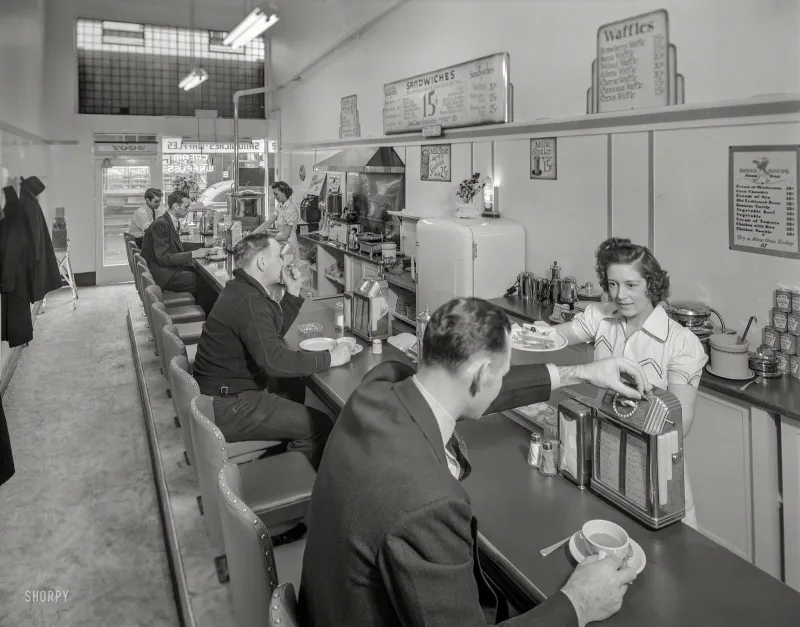
Photo: 1940s American diner bar wartime espionage vintage noir atmosphere, via 3.bp.blogspot.com
The Nazi Spy Who Couldn't Stop Talking Like a Textbook — And Got Caught Because of It
The Germans were meticulous. That much is worth acknowledging upfront. The training programs that produced their American-embedded agents during World War II were serious, resource-intensive operations. Recruits were drilled on American geography, cultural customs, currency, and slang. They were given backstories — plausible, detailed, cross-referenced biographies that could withstand scrutiny. They were taught to dress like Americans, move like Americans, and think like Americans.
What the trainers apparently couldn't teach, and what Allied counterintelligence eventually realized was more revealing than almost any other indicator, was how Americans talked when nobody was being formal about it.
The Problem With Perfect English
There's a particular kind of English that gets taught in foreign language programs — precise, grammatically immaculate, and almost entirely unlike what you'd hear in an American diner at seven in the morning. It's the English of textbooks and structured lessons, where every sentence is complete, every contraction is properly deployed, and idioms are used only when the instructor has explicitly introduced them.
Real American speech, especially mid-20th century American speech, worked by entirely different rules. It was regional, it was sloppy in specific ways that varied by city and class and profession, it was full of references that made no sense outside their local context, and it changed fast enough that a phrase that sounded current in 1938 could mark someone as a stranger by 1943.
German intelligence understood this problem intellectually. What they couldn't fully solve was the gap between understanding it and fixing it — because the only way to genuinely absorb the texture of everyday American language was to spend years living inside it, not weeks studying it in a training facility outside Hamburg.
When the Wrong Word Gives Everything Away
Allied counterintelligence — a patchwork of FBI operations, military intelligence units, and the precursor organizations to what would become the CIA — began noticing a pattern in the reports they were receiving from civilian sources during the early years of the war. People were flagging strangers not because those strangers had done anything overtly suspicious, but because something about the way they spoke felt wrong in a way that was hard to articulate.
A man in a Philadelphia bar ordered a drink and then said something to the bartender that was — technically, grammatically, structurally — completely fine. But it wasn't how anyone would actually say it. The phrasing was too careful. The words were chosen in a sequence that made sense on paper but felt assembled rather than natural. The bartender, who couldn't have explained exactly what bothered him, mentioned it to a neighbor who had a contact at the local FBI field office.
This pattern repeated itself in grocery stores, on buses, in rooming houses. The complaints were frustratingly vague — "he just didn't sound right," "something was off about how he talked," "nobody talks like that" — but they kept pointing at the same underlying phenomenon. Agents who had been trained to speak American English had learned the words without absorbing the music.
Formal constructions that no American would use in casual conversation. The wrong level of politeness for the context — too deferential in situations where Americans would be brusque, too blunt in situations that called for small talk. Idioms used with a slight delay, as if retrieved from memory rather than produced automatically. Slang that was technically correct but applied to the wrong situations, like someone who had learned what a word meant without ever hearing it used naturally.
The Hardest Thing to Fake
Counterterrorism and counterintelligence researchers who have studied this period point to what they call the "native speaker baseline" problem: the fact that genuine fluency in a language isn't really about grammar or vocabulary at all. It's about the thousands of micro-decisions that native speakers make automatically and unconsciously in every conversation — when to trail off, when to interrupt, when to use a formal register versus a casual one, which topics require which tone.
Those decisions get made below the level of conscious thought in people who grew up speaking a language. They can't be memorized because they were never learned — they were absorbed over years of social experience. And when they're missing, even people with no linguistic training can feel the absence, even if they can't name it.
The FBI's wartime counterintelligence operations eventually formalized this insight, training agents to specifically probe suspects' language patterns in casual conversation — asking about local sports teams, neighborhood landmarks, recent news stories — and listening not for wrong answers but for wrong delivery. A spy who had memorized the name of a local baseball player might still stumble on the rhythm of how a real fan would bring it up.
What the Spy Catchers Learned
The broader lesson that emerged from these cases outlasted the war by decades. Language, it turns out, is one of the most durable identity markers that exists — more reliable in many ways than physical appearance, more difficult to alter than documentation, and far harder to fake than most intelligence services of the era had assumed.
The German agents who were caught through language alone weren't careless or unintelligent. Many of them were, by any objective measure, remarkably well-prepared. They simply couldn't overcome a fundamental reality: you cannot convincingly perform an identity you haven't lived.
The bartenders and shopkeepers and neighbors who flagged them weren't trained operatives. They were just people who had spent their whole lives listening to the way Americans talk — and recognized, instantly, when something didn't quite fit.
Sometimes the most sophisticated surveillance system in the world is just a guy at a lunch counter who thinks, that's not how anybody I know would say that.