The Fungus That Puppets Ants — And Made Scientists Question Their Own Minds
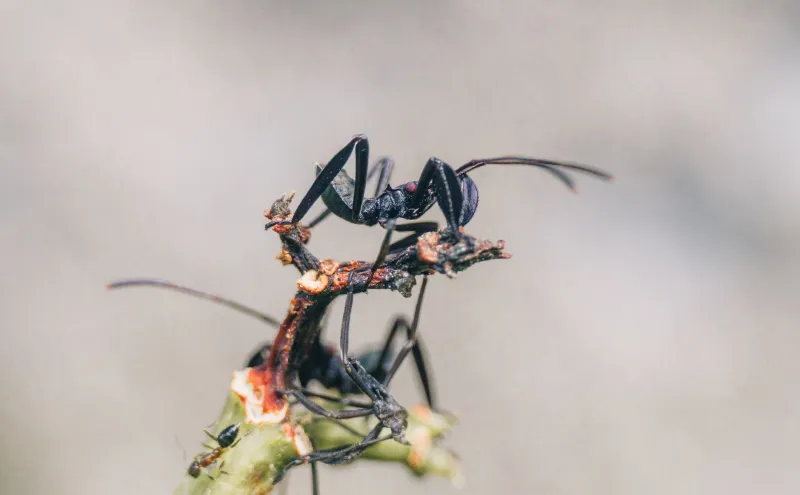
There Are Things in the Forest That Wear Other Things
Deep in the tropical understory — in places like the forests of Thailand, Brazil, and the American Southeast — there is a fungus that does something so precisely, deliberately horrible that when scientists first described it in detail, several of them reportedly had to sit down.
Ophiocordyceps unilateralis, commonly known as the zombie-ant fungus, does not simply infect its host. It conducts it. A carpenter ant that encounters the fungus's spores becomes, within days, something that is no longer entirely an ant. The fungus spreads through the insect's body, bypasses the exoskeleton's defenses, and begins chemically interacting with the ant's nervous system in ways that researchers are still working to fully understand.
What they do understand is the result: the ant leaves its colony, climbs a plant stem to a very specific height — typically around 25 centimeters above the forest floor, within a narrow band of temperature and humidity that optimizes spore dispersal — clamps its mandibles around a leaf vein in a grip so powerful that it persists after death, and then dies. Right there. At that height. In that position.
The fungus then erupts through the ant's head and releases its spores downward, onto the foraging trails below.
It is, from a purely mechanical standpoint, one of the most sophisticated biological systems ever documented. It is also, from almost any other standpoint, absolutely horrifying.
When the Lab Becomes Part of the Experiment
For the researchers who study Ophiocordyceps in field conditions, proximity to the organism is unavoidable. You can't observe zombie ants from a comfortable distance — the behavior happens in dense vegetation, often at low light levels, and requires sustained close observation to document properly.
So when a research team working out of a tropical field station in Southeast Asia in the early 2000s began noticing that the fungus had established itself not just in their study plots but within the station compound itself — on food stores, on equipment surfaces, in the gaps between structural materials — the initial response was practical. They needed to contain it. Sterilize affected areas. Adjust their protocols.
Then one of the junior researchers made a joke that wasn't entirely a joke: how would they know if any of them had been exposed?
The laughter that followed was reportedly a little strained.
What the Fungus Actually Does to a Brain
Here's where the science gets genuinely strange, and why that joke landed with more weight than it should have.
For years, researchers assumed that Ophiocordyceps was controlling ant behavior by physically invading the brain — essentially overwriting the ant's neural tissue with fungal matter. But a landmark 2017 study out of Penn State found something more disturbing: the fungus doesn't actually enter the brain at all.
Instead, it surrounds the muscles throughout the ant's body — particularly those controlling the legs and mandibles — and manipulates them directly, while leaving the brain itself largely intact. The ant's own nervous system continues to function. It just finds itself unable to resist commands being issued by something wrapped around every muscle it has.
The brain is still in there. It's just not in charge anymore.
The implications of that finding rippled through the research community in ways that went beyond entomology. If a pathogen could achieve that level of behavioral control without even touching the central nervous system, what did that say about the range of mechanisms through which biological agents might influence behavior in other species?
In humans, for instance.
The Uncomfortable Question Scientists Actually Asked
The field station contamination incident — which was documented in internal research logs and later discussed in published literature on field safety protocols — forced the team into a genuinely unusual conversation.
Ophiocordyceps is not known to infect mammals. The scientific consensus on this is clear and consistent: the fungus is highly host-specific, and humans are not on its list. Exposure to spores does not cause infection in people.
But.
The researchers were aware that several other fungal organisms — including Toxoplasma gondii, which is technically a parasite rather than a fungus but operates on similar behavioral-manipulation principles — had been found to subtly alter decision-making and risk assessment in humans. The mechanisms were different, the effects were far subtler, but the basic concept — a biological agent influencing behavior without the host's awareness — was not science fiction. It was documented science.
So when the team sat down to review their own recent decisions and found a cluster of choices that, in retrospect, seemed oddly consistent with maximizing time spent in the contaminated areas of the station, the conversation got weird fast.
Had they been unconsciously gravitating toward the affected zones? Had some low-level chemical signal from the fungal presence been shaping their movements in ways they hadn't registered consciously?
Almost certainly not. The researchers knew this. They said so explicitly in their notes.
They also kept checking.
What Gets Left Behind
The station was decontaminated. Protocols were updated. The research continued, and the team published work on Ophiocordyceps that contributed meaningfully to the field's understanding of parasitic behavioral manipulation.
But the incident left something behind that's harder to quantify than a spore count.
Scientists who study behavioral manipulation — whether in ants, in rodents, or in the emerging field of how gut microbiomes influence human mood and decision-making — will tell you that the most unsettling part of the work isn't the exotic cases. It's the growing realization that autonomy is not a binary condition. That the line between "I decided this" and "something influenced me to decide this" is blurrier than most of us want to believe.
The zombie ant doesn't know it's being puppeted. It experiences, as far as anyone can determine, something like normal ant cognition right up until it clamps onto that leaf.
The fungus doesn't need it to know. It just needs it to climb.