Nobody Was Flying the Plane — And That Was Somehow Fine
The Flight That Shouldn't Have Gone This Well
Picture yourself at 35,000 feet. The engines are humming. The drink cart just passed your row. And somewhere up front, behind a reinforced door, two pilots are watching their instrument panels go dark one by one — not because something is failing slowly, but because a cascading software glitch is eating through the aircraft's computer systems like a fire through dry paper.
That's roughly what happened aboard a Boeing 757 test flight in 1995, and the punchline — if you can call it that — is that the plane landed safely anyway. Not because of heroic piloting. Not because of a miraculous mechanical recovery. But because the autopilot, running on a separate processing thread that the bug hadn't yet reached, quietly decided it had a job to do and went ahead and did it.
The pilots, by most accounts, spent a significant portion of the descent as spectators.
What Actually Broke
To understand why this is so strange, you need a quick primer on how modern commercial aircraft manage their own brains.
By the mid-1990s, fly-by-wire technology had fundamentally changed aviation. Instead of mechanical cables connecting a pilot's inputs to the plane's control surfaces, computers were now the middlemen. You push the yoke; a computer interprets that input and tells the ailerons what to do. This introduced extraordinary precision and allowed planes to correct for turbulence, wind shear, and human error faster than any human could manage.
But it also introduced a new category of vulnerability: software failure.
The glitch that struck during this particular test flight — conducted under controlled conditions with FAA observers on board — was what engineers call a fault cascade. One corrupted process triggered errors in adjacent systems, which triggered more errors, which began pulling down displays and disabling manual override functions in sequence. It was the aviation equivalent of a browser crash taking your entire operating system with it.
What the engineers had not fully anticipated was how the aircraft's redundant autopilot architecture would respond to being essentially the last system standing.
The Plane Decided to Handle It
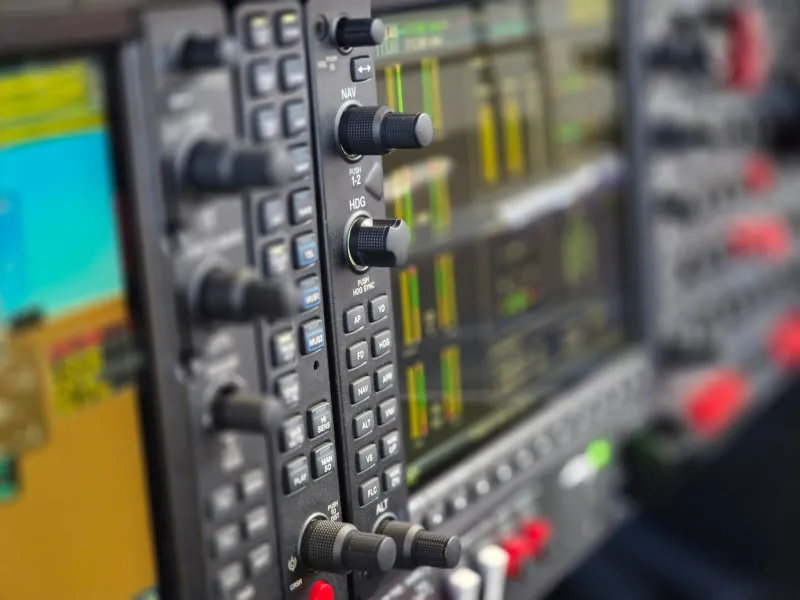
Modern autopilot systems are designed to be paranoid. They cross-check their own data constantly, comparing inputs from multiple sensors and refusing to act on any reading that doesn't match the consensus. When the primary flight computers began throwing errors, the autopilot didn't panic. It assessed what data it still had access to — altitude, airspeed, GPS positioning, engine thrust — determined that the information was reliable, and continued doing its job.
Which, at that moment, was to bring the plane down.
The approach wasn't textbook perfect. There were moments where the system had to compensate for incomplete information, making adjustments that a human pilot would have handled differently. But the aircraft stayed on a stable glide path, maintained appropriate speed, and touched down on the runway without incident.
When it was over, one of the FAA observers reportedly turned to a Boeing engineer and asked, only half-joking, whether the pilots had been necessary at all.
The answer, to everyone's significant relief, was still yes — but the question landed differently than it might have a decade earlier.
Why the FAA Couldn't Just Call It a Win and Move On
Here's the uncomfortable part of this story: a plane landing itself during a catastrophic system failure is not straightforwardly good news.
Safety regulators had spent decades building aviation protocols around a core assumption — that pilots are always the final authority. Every redundancy, every checklist, every emergency procedure was designed to preserve and support human decision-making at the top of the chain. The 1995 incident didn't just reveal a software bug; it revealed a scenario that the entire framework hadn't accounted for.
What happens when the human is locked out and the machine succeeds anyway? Who is responsible for that outcome? And more pressingly: what if the machine had made a different choice?
The FAA launched an extended review of fly-by-wire failure protocols that stretched into the late 1990s. Engineers at Boeing and Airbus both revisited their redundancy architectures, not to prevent autopilots from taking control during emergencies, but to define exactly under what conditions they should, and what constraints they needed to operate within when they did.
New certification standards emerged that required aircraft to demonstrate — not just theorize — how their systems would behave during compound failures. The test flight that had accidentally become the world's most unsettling safety demo ended up serving as the template for what those demonstrations needed to prove.
The Quiet Revolution Nobody Announced
There was no press conference. No dramatic headline about the day a computer saved 200 lives. The 1995 incident stayed largely within aviation industry circles, discussed in engineering reviews and FAA briefings rather than evening news segments.
Partly that was deliberate. Airlines have always understood that public confidence is fragile, and "the autopilot flew the plane because the pilots couldn't" is not a sentence that sells tickets.
But partly it was because the outcome was genuinely hard to categorize. Was it a near-disaster? Technically, yes — a catastrophic system failure on a commercial aircraft is by definition a serious event. Was it a triumph of engineering? Also yes. Was it a warning about over-reliance on automated systems? Absolutely.
It managed to be all three at once, which is probably why it still makes aviation engineers slightly uncomfortable when you bring it up.
The planes flying over your house today are the direct descendants of the lessons learned from that flight. Their autopilot systems are more carefully constrained, more thoroughly tested, and more precisely defined in terms of when they're allowed to take the wheel.
Which is reassuring. Mostly.
The part that still gives people pause is the part nobody planned for: when everything went wrong, the machine got it right. And nobody quite knows whether to be grateful or unnerved by that.