He Reached Into a Box, Grabbed the Wrong Part, and Accidentally Built Something That's Kept Tens of Millions of Hearts Beating
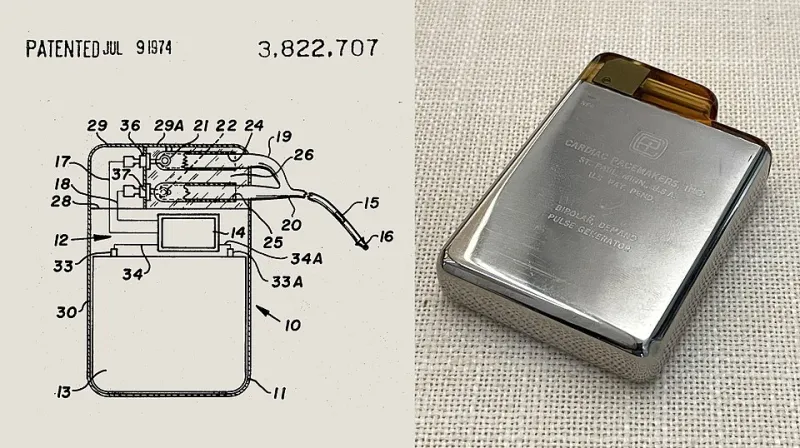
Photo: Brian Adducci , Public domain, via Wikimedia Commons
He Reached Into a Box, Grabbed the Wrong Part, and Accidentally Built Something That's Kept Tens of Millions of Hearts Beating
There's a version of history where Wilson Greatbatch reaches into that box, grabs the right resistor, finishes his heart rhythm recorder, and goes home for dinner. Nobody remembers his name. Millions of people die who didn't have to.
 Photo: Wilson Greatbatch, via i.ytimg.com
That's not the version that happened.
Just a Guy in a Barn
In 1956, Greatbatch was an electrical engineer at the University of Buffalo — not a doctor, not a cardiologist, not anyone with a formal stake in the future of cardiac medicine. He was working on a device designed to simply record heart rhythms, a fairly straightforward piece of equipment that would help physicians study how the heart behaved electrically. Routine stuff, by the standards of the time.
 Photo: University of Buffalo, via wallpapers.com
He was doing much of this tinkering in a barn workshop behind his house in western New York — the kind of cluttered, component-filled space that engineers of that era practically lived in. Resistors, capacitors, wires, and circuit boards were everywhere, sorted loosely into boxes that weren't always as organized as they probably should have been.
On one particular afternoon, Greatbatch reached into a box for a 10,000-ohm resistor. He pulled out a 1-megaohm resistor instead — a part with one hundred times the resistance of what he needed. He installed it into his circuit anyway, probably figuring he'd sort it out in a moment, and switched the device on.
What happened next stopped him cold.
The Pulse That Changed Everything
Instead of recording a steady electrical signal, the circuit began producing rhythmic pulses — a steady, repeating electrical beat that mimicked, almost perfectly, the natural rhythm of a human heart. Greatbatch stared at what he'd built for about a minute and a half. Then, by his own account, he realized he was looking at something that had never existed before: a small, self-contained circuit capable of artificially driving a heartbeat.
The implications were staggering. At the time, people whose hearts beat too slowly or irregularly — a condition called heart block — had few options. External pacemakers existed, but they were massive, plug-in-the-wall machines that required patients to remain tethered to a power outlet. Some were large enough to fill a cart. They were life-sustaining, but they were also completely impractical for anything resembling a normal life.
What Greatbatch's wrong-resistor circuit suggested was the possibility of something small enough to place inside the body. Something that could travel with you. Something that could become, in effect, invisible.
From the Barn to the Operating Room
Greatbatch spent the next two years refining his accidental discovery, working with cardiac surgeon William Chardack and engineer Andrew Gage to develop a device that could actually survive inside a human body. The engineering challenges were enormous — electronics and human tissue don't naturally get along, and the batteries of the 1950s weren't built with longevity in mind.
In 1958, they implanted the first experimental pacemaker into a dog. It worked. In 1960, they implanted one into a human patient. It worked too. That first patient lived for another 18 months — not a long time, but long enough to prove the concept was real and the technology was viable.
Greatbatch went on to patent the device and eventually license it to Medtronic, a medical technology company that would become one of the most important names in cardiac care. He later spent years solving the battery problem, developing lithium-iodide cells that could power implanted devices for a decade or more without replacement.
The Razor-Thin Line
What makes this story so hard to shake is how completely unremarkable the moment of invention actually was. Greatbatch didn't have a dramatic epiphany. He wasn't struck by inspiration in the middle of the night. He just grabbed the wrong thing out of a disorganized box and paid attention to what happened next.
Medical history is littered with accidents — penicillin grew on a contaminated petri dish, X-rays were discovered during a routine experiment with cathode rays, Velcro came from a frustrated Swiss engineer picking burrs off his dog. But the pacemaker story feels different somehow, because the wrong part was so wrong, and the result was so right.
Today, roughly 600,000 pacemakers are implanted in the United States every year. Globally, the number of people currently living with an implanted cardiac pacemaker is estimated in the tens of millions. Every single one of those devices traces its lineage, in a direct and unbroken line, back to a barn in western New York and a man who grabbed the wrong resistor.
Greatbatch himself lived to 92, passing away in 2011. He held more than 150 patents over his lifetime and was inducted into the National Inventors Hall of Fame. But when people asked him about the pacemaker — the one that started everything — he tended to tell the story simply and without much embellishment.
 Photo: National Inventors Hall of Fame, via www.themontclairgirl.com
He grabbed the wrong part. He noticed what it did. He didn't throw it away.
Sometimes that's all invention really is.