The Purple Revolution: How a Failed Chemistry Assignment Changed Fashion Forever
When Homework Goes Horribly Right
Picture this: You're eighteen years old, hunched over a chemistry set in your parents' attic, desperately trying to synthesize quinine for your professor. Instead of the clear, medicinal compound you're after, you end up with a disgusting black sludge that looks like something you'd scrape off the bottom of a shoe.
Most students would dump it down the drain and start over. William Henry Perkin decided to see what would happen if he added alcohol to the mess.
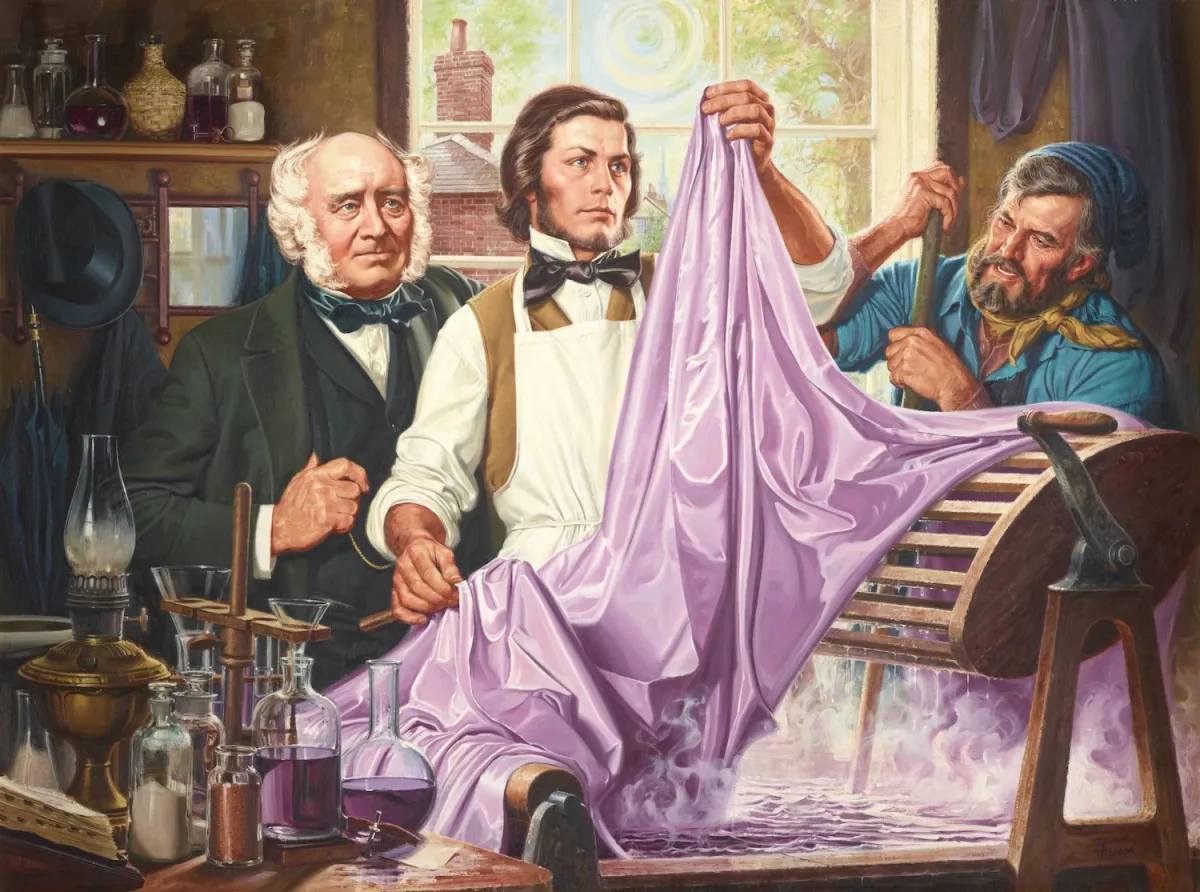 Photo: William Henry Perkin, via www.sciencehistory.org
That decision in 1856 didn't just save his grade—it accidentally launched the synthetic dye industry and turned the entire Victorian world purple.
The Accident That Sparked a Revolution
Perkin was a student at the Royal College of Chemistry in London, working under the legendary German chemist August Wilhelm von Hofmann. The assignment seemed straightforward enough: create synthetic quinine to help treat malaria, a disease that was decimating British troops in tropical colonies.
 Photo: Royal College of Chemistry, via newcdn.igromania.ru
Quinine came from the bark of South American cinchona trees, making it expensive and difficult to obtain. If someone could synthesize it artificially, they'd solve a massive public health crisis and probably make a fortune.
But Perkin's experiment went spectacularly wrong. Instead of producing anything resembling quinine, his coal tar derivatives created what looked like industrial waste. Any reasonable person would have considered it a complete failure.
Perkin wasn't reasonable. He was curious.
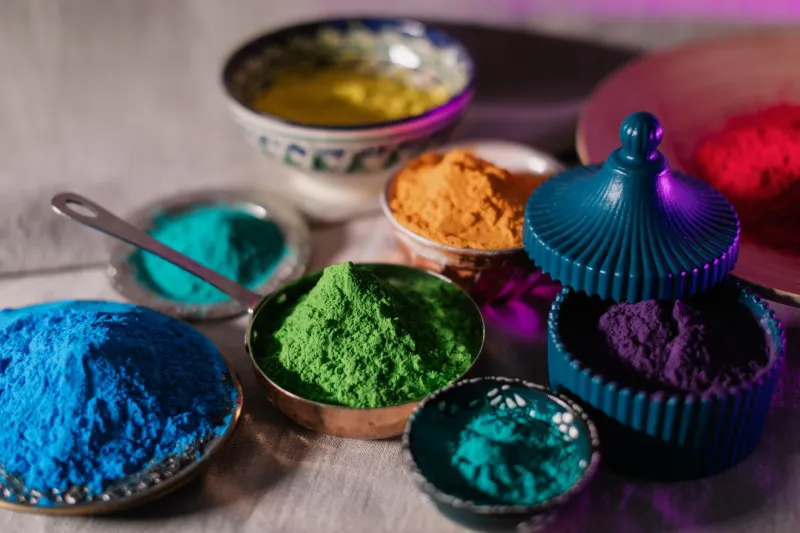
When he dissolved the black gunk in alcohol, something extraordinary happened. The solution turned a brilliant, luminous purple unlike anything anyone had ever seen before.
The Color That Didn't Exist
To understand why this mattered, you need to know that purple had always been the most exclusive color in human history. For thousands of years, the only way to create purple dye was by harvesting thousands of murex sea snails and extracting tiny amounts of pigment from their shells. It took roughly 250,000 snails to produce one ounce of Tyrian purple.
This made purple clothing so expensive that only emperors and the ultra-wealthy could afford it. Purple literally meant power.
Perkin had just created purple in his attic using coal tar—a waste product from gas production that was so abundant, companies paid people to haul it away.
From Chemistry Student to Chemical Mogul
Perkin immediately recognized what he'd stumbled onto. He filed for a patent, dropped out of college (much to his professor's horror), and convinced his father to invest in building a chemical factory.
His timing was perfect. The 1850s marked the beginning of the Industrial Revolution's fashion boom. Middle-class families suddenly had disposable income and wanted to dress like aristocrats. Perkin's "mauveine"—named after the French word for the mallow flower—gave them that chance.
The first mauve dress appeared in London in 1857. Within months, every fashionable woman in Europe wanted one. Queen Victoria herself appeared at her daughter's wedding wearing mauve silk, essentially giving the color royal endorsement.
 Photo: Queen Victoria, via i.pinimg.com
Purple Mania Takes Over
What happened next defied all logic. Purple became so popular that newspapers started calling the phenomenon "mauve mania." Department stores couldn't keep purple fabric in stock. Fashion magazines declared that any woman not wearing purple was hopelessly behind the times.
The craze spread beyond clothing. Purple ribbons, purple curtains, purple wallpaper—if it could be dyed, someone painted it purple. Charles Dickens complained that London looked like it had been "attacked by a regiment of violets."
Perkin's factory couldn't keep up with demand. He expanded production, hired hundreds of workers, and watched money pour in faster than he could count it. By age 21, he was one of the wealthiest men in England.
The Irony of Success
Here's the strangest part of the story: Perkin spent years trying to give his discovery away to established chemical companies, and none of them wanted it.
Before building his own factory, he approached every major dye manufacturer in Europe. They all told him the same thing: there was no market for artificial colors. Natural dyes had worked fine for thousands of years. Why would anyone want something made from coal tar?
Even his own professor thought he was making a terrible mistake. Hofmann believed chemistry should focus on medicine and scientific advancement, not fashion accessories. He spent years trying to convince Perkin to return to "serious" chemistry.
Perkin ignored them all and became rich enough to fund his own research for the rest of his life.
The Legacy of a Beautiful Mistake
Perkin's accidental discovery launched the entire synthetic chemistry industry. Within a decade, chemists had created dozens of new colors, each more vibrant than anything nature could produce. The German chemical industry, in particular, recognized the potential and dominated synthetic dye production for the next century.
More importantly, Perkin proved that industrial chemistry could transform everyday life. His success inspired a generation of chemists to experiment with artificial materials, leading to everything from aspirin to plastics.
By the time Perkin retired in 1874—at age 36—he had revolutionized both chemistry and fashion. The teenager who failed to cure malaria had accidentally cured something else entirely: humanity's dependence on nature for color.
The Ultimate Chemistry Success Story
Today, synthetic dyes are so common we forget they were ever remarkable. Every piece of colored clothing you own likely contains descendants of Perkin's original mauveine formula.
But the real lesson of Perkin's story isn't about chemistry or fashion—it's about the power of productive failure. Sometimes the most important discoveries happen when we're trying to solve completely different problems.
Perkin never did synthesize quinine. That breakthrough wouldn't come for another 88 years. But his "failed" experiment changed the world in ways he never could have imagined, proving that sometimes the best way to find what you're looking for is to accidentally find something better.